

Treating Impacted Canine Teeth
An impacted canine is a permanent canine tooth that cannot erupt into its normal position because it is blocked, traveling in the wrong direction, or does not have enough room. Upper permanent canines are the second most frequently impacted teeth after third molars. Treatment may involve creating space, surgical exposure, and braces traction to guide the canine into the dental arch.
Parents often notice the problem because one permanent canine never appears, a baby canine stays in place longer than expected, or one side of the smile develops differently from the other. Adults may discover an impacted canine on an X-ray even though the tooth has never hurt. In my Riverdale orthodontic office in the Bronx, I focus first on where the canine is located, why it has not erupted, whether nearby teeth are at risk, and whether the natural canine can be guided into the smile safely.
🦷 What Is an Impacted Canine Tooth?
A permanent canine normally develops inside the jaw and follows an eruption path into the dental arch. An impacted canine becomes stuck before it reaches its normal position. The tooth may remain under the gum or bone, erupt only partially, or travel away from the space where it belongs.
Upper canines are especially important in orthodontics because they are prominent in the smile and contribute to a healthy bite. An impacted upper canine may sit toward the palate, toward the cheek, high above the dental arch, or close to the roots of the front teeth. Some impacted canines cause pain or swelling, but many cause no symptoms and are found only during an examination or on dental imaging.
Related reading: Impacted and Missing Teeth
🦷 Why an Upper Canine Can Become Impacted
Canine impaction is usually multifactorial, which means more than one factor may contribute in the same patient. The most common reasons I evaluate include:
- Not enough space in the dental arch. Crowding or a narrow arch can leave the permanent canine without a clear path into the smile.
- An abnormal eruption path. The canine may develop at an angle or travel toward the palate, cheek, or roots of neighboring teeth instead of toward its normal position.
- A retained primary canine. A baby canine that remains longer than expected can be an important clue that the permanent canine is not erupting normally.
- A physical obstruction. A supernumerary tooth, odontoma, cyst, or another local obstruction can block eruption.
- Developmental and genetic factors. Impacted canines can occur with other dental-development differences and can show a familial pattern.
The exact cause matters because the treatment for a canine that is simply short on space can be different from the treatment for a canine that is severely displaced or blocked by another structure.
Related reading: How Can I Fix My Crowded Teeth?
🦷 Why I Do Not Recommend Ignoring an Impacted Canine
An impacted canine is not only a cosmetic issue. One of my main concerns is the relationship between the impacted canine and the roots of the neighboring front teeth. When an upper canine travels too close to the lateral or central incisor roots, the contact can contribute to external root resorption, which means part of the neighboring root is lost.
Root resorption can develop without pain. That is why a patient can feel completely normal while the impacted canine is creating a problem underneath the gum. The risk is not the same in every case, but it is one reason delayed or abnormal canine eruption deserves an orthodontic evaluation.
Depending on its position, an impacted canine can also contribute to crowding and loss of space where the canine should erupt, displacement of neighboring teeth, a dental midline that shifts away from its ideal position, a visible gap or missing canine in the smile, damage to adjacent tooth roots, cyst formation in some cases, and a bite that develops without the canine in its intended position.
🦷 How I Diagnose an Impacted Canine
My evaluation starts with the eruption pattern in the mouth. I look at whether the permanent canine has appeared, whether a baby canine is still present, how much room exists in the arch, whether the right and left sides are developing symmetrically, and whether the canine can be felt under the gum.
A panoramic X-ray can show the general position and angle of the canine. In selected cases, cone-beam CT imaging can provide three-dimensional information about the canine and its relationship to nearby roots. I do not use CBCT automatically for every delayed canine. I use three-dimensional imaging when the added information is likely to affect diagnosis, risk assessment, or treatment planning. Learn more about what happens at your first orthodontic appointment.
The questions I need to answer are specific: Where is the canine? Is there enough room for it? Is something blocking it? Is the canine close to the roots of the front teeth? Can the natural tooth be guided into the arch safely?
🦷 A Real Impacted Canine Treatment Sequence
The panoramic X-rays below document an actual orthodontic treatment sequence provided by Schimmel Orthodontics. This case involved impacted upper canines on both sides. The images show the major stages patients and parents often hear about during consultation: preparing space, surgical exposure and attachment, orthodontic traction, and bringing the canines into the dental arch.
Stage 1: Creating and Protecting Space for the Canines
When lack of space is part of the problem, I first need to create or preserve enough room for the permanent canines. Braces are useful because I can move the neighboring teeth while maintaining the space that each canine will eventually occupy. Depending on the case, space management may also involve arch development, removal of a retained primary tooth, or another diagnosis-specific approach.
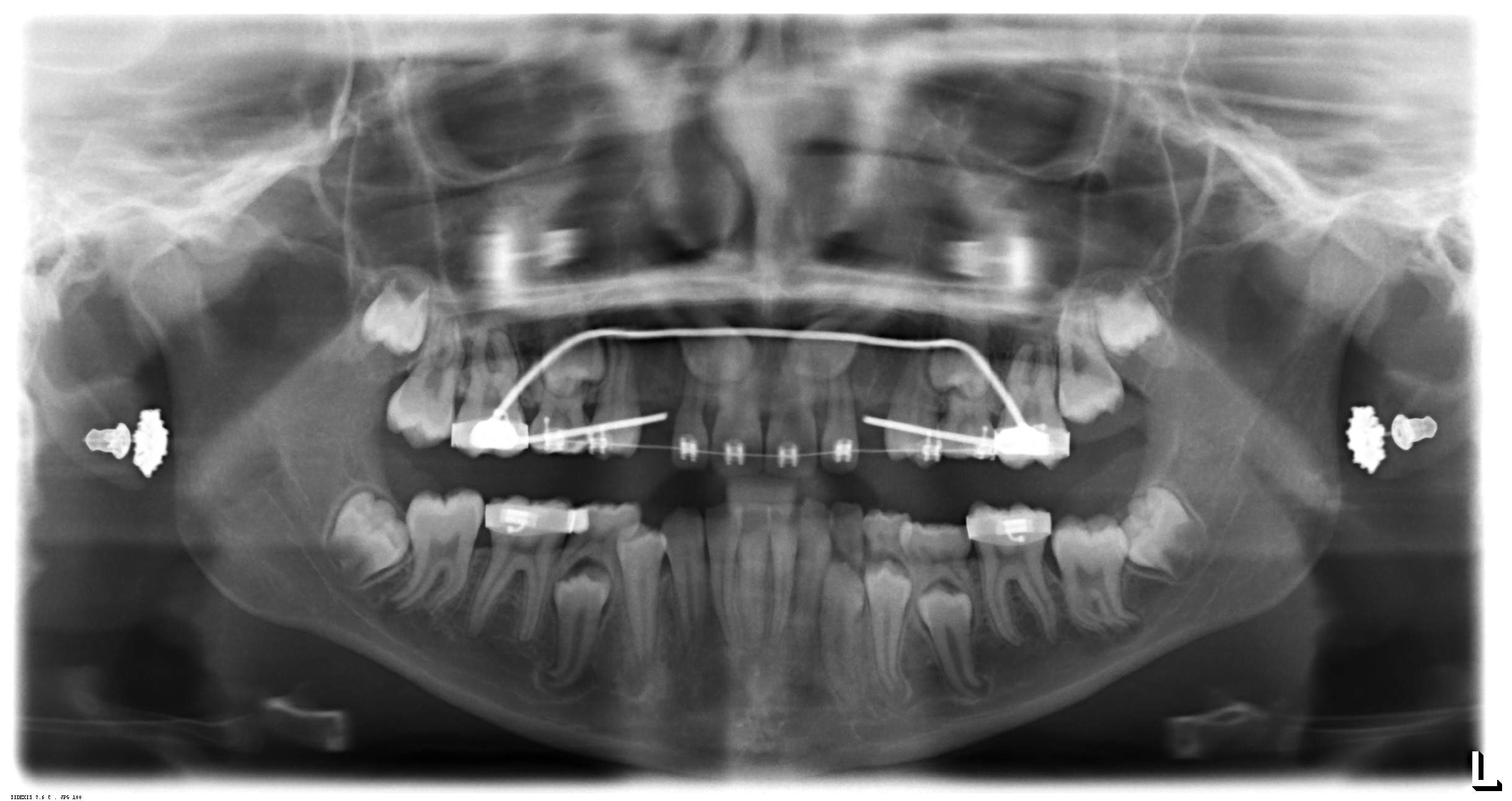
The impacted upper canines remain above the dental arch while braces prepare and maintain the space needed for eruption.
Creating space is important because I cannot guide a canine into a position that is already occupied. The goal at this stage is to prepare a safe path and establish the anchorage needed for the next phase of treatment.
Stage 2: Surgical Exposure and Bonding an Attachment
If an impacted canine remains trapped under gum or bone and is unlikely to erupt into the arch on its own, I may coordinate care with an oral surgeon. During surgical exposure, the surgeon uncovers enough of the tooth to bond a small orthodontic attachment. A chain or similar connection can then be used so I can apply gentle orthodontic traction.
The purpose of exposure is not to pull the tooth into place in one step. The purpose is to give me controlled access to the tooth so I can guide it gradually along a planned path while protecting the surrounding teeth and tissues.

Orthodontic attachments and chains are visible on the impacted upper canines so controlled traction can begin.
Stage 3: Guiding the Canines Into the Arch With Braces
After the attachment is in place, I use light, controlled orthodontic force to move the canine. The tooth may need to travel through bone and gum tissue before it reaches the space prepared for it. As the canine moves, I adjust the mechanics and monitor the surrounding teeth so the force stays directed along the safest practical path.
Anchorage is important. Pulling on an impacted canine creates forces elsewhere in the mouth, so I may use braces and additional fixed components to stabilize other teeth while the impacted tooth moves. Once enough of the canine has erupted, I can integrate the tooth into the regular braces system and continue aligning it with the rest of the arch.
Related reading: Types of Braces Explained
Stage 4: Bringing the Natural Canines Into the Smile
The final radiograph in this sequence shows the previously impacted canines brought into the dental arch. This is the goal when the natural canine can be preserved and moved into a healthy, functional position.

The previously impacted upper canines have been guided into position as orthodontic treatment continues.
Treatment is not necessarily finished the moment the canine reaches the arch. I still need to refine its position, coordinate it with the neighboring teeth, and finish the bite. The result depends on the starting position of the tooth, the available space, the response to traction, and the rest of the orthodontic treatment goals.
🦷 Why Braces Are Often Important for Impacted Canine Treatment
Impacted canine treatment is a good example of why fixed braces remain valuable in modern orthodontics. I may need to hold one group of teeth stable while moving another tooth. I may need to create space first and protect that space for months. I may also need to change the direction of force as the canine moves closer to the arch.
Clear aligners are excellent for many orthodontic problems, but a deeply impacted canine that requires surgical exposure and traction is a different type of case from straightforward alignment. In these cases, I often prefer fixed braces or fixed anchorage because they give me continuous control over the traction mechanics. The appliance choice still depends on the individual case.
🦷 Can an Impacted Canine Come In Without Surgery?
Yes, in selected cases. An unerupted or displaced canine does not automatically mean surgical exposure will be necessary. Age, canine position, angulation, available space, retained baby teeth, and the relationship to nearby roots all affect the treatment decision.
When an eruption problem is identified early, creating space or removing a local obstacle can sometimes improve the chance of eruption. Pediatric dental guidance also supports early assessment of asymmetric canine eruption and retained primary canines so interceptive treatment can be considered when appropriate.
A canine that is deeply displaced, remains impacted despite adequate space, or is positioned in a way that is unlikely to self-correct may require surgical exposure and orthodontic traction. Early evaluation does not guarantee simpler treatment, but it can give us more information and sometimes more options.
🦷 What If the Impacted Canine Cannot Be Brought Into the Arch?
My preference is to evaluate whether the natural canine can be preserved and positioned properly, but not every impacted canine should automatically be pulled into the arch. The tooth may be ankylosed to bone, severely displaced, resorbed, associated with pathology, or positioned so that moving it would create unacceptable risk to neighboring teeth.
Depending on the diagnosis, management can include monitoring, creating space and observing eruption, removing a retained primary tooth or obstruction, surgical exposure and orthodontic traction, or extraction of the impacted canine in selected cases. The best option depends on the canine position, patient age, health of adjacent teeth, and overall bite and treatment goals.
🦷 What Patients Should Expect During Impacted Canine Treatment
Impacted canine treatment usually requires patience because I am moving a tooth that started outside the normal eruption path. Orthodontic visits are used to adjust traction, maintain space, and monitor how the canine and neighboring teeth are responding. Surgical exposure can cause temporary soreness and swelling, and the oral surgeon provides the specific postoperative instructions for that part of care.
There is no responsible universal timeline. A canine that is close to the arch and favorably angled can behave very differently from a canine positioned high in the jaw, crossing nearby roots, or requiring substantial space creation. Treatment time can be influenced by the depth and angle of the impaction, patient age, distance the tooth must travel, available space, whether surgery is required, and how the tooth responds to traction.
🦷 Why Early Detection of an Impacted Canine Matters
The American Association of Orthodontists recommends a first orthodontic evaluation no later than age 7. That does not mean a seven-year-old with developing canines needs braces. It means an orthodontist can identify developing space and eruption problems before every permanent tooth is expected to be in the mouth. Often an impacted canine can be prevented by removing the primary (baby) canine at the appropriate time.
As the permanent canines develop, I pay attention to symmetry, available space, retained baby teeth, and the direction of eruption. If a canine is moving toward the roots of the front teeth or losing its normal eruption path, earlier recognition can help me decide whether observation, space management, additional imaging, or interceptive treatment is appropriate.
🦷 Impacted Canine Treatment in Riverdale, the Bronx, Kingsbridge, Yonkers, and Westchester
If your child's permanent canine has not come in, a baby canine is still present longer than expected, one canine erupted while the other did not, or your dentist has identified an abnormal canine position on an X-ray, an orthodontic evaluation can show what is happening before the problem becomes more complicated.
I evaluate and treat impacted teeth, crowding, blocked-out teeth, and other eruption problems in my Riverdale orthodontic office in the Bronx. I also see patients from Kingsbridge, Yonkers, Westchester, and nearby communities. My job is to determine where the canine is, why it has not erupted normally, whether nearby teeth are at risk, and whether the natural canine can be brought into the smile.
Some patients need monitoring. Some need space created. Some need coordinated treatment with an oral surgeon followed by braces and orthodontic traction. The important step is finding out which situation you or your child actually has. See more real results in our smile gallery.
Schedule a consultation: Contact Schimmel Orthodontics in Riverdale and the Bronx
Wondering If a Impacted Canine Needs Attention?
Schimmel Orthodontic Associates evaluates and treats impacted canine teeth for children, teens, and adults in Riverdale, Kingsbridge, Bronx NY, Yonkers, and Westchester County.
Call (718) 548-4768🦷 FAQs About Impacted Canine Teeth
Can braces pull down an impacted canine?
Does every impacted canine need surgery?
When should I worry if a permanent canine has not come in?
Can an impacted canine damage the front teeth?
How long does it take to bring an impacted canine into the smile?
Can Invisalign treat an impacted canine?
Where can I get impacted canine treatment near Riverdale or the Bronx?
🦷 Related reading
- Impacted and Missing Teeth at Schimmel Orthodontics
- How Can I Fix My Crowded Teeth?
- Types of Braces Explained
- Invisalign vs Braces: Riverdale Orthodontist Dr. Schimmel Explains
- Your First Orthodontic Appointment
- Children's and Teen Orthodontics at Schimmel Orthodontics
- Adult Braces at Schimmel Orthodontics
Sources
- American Association of Orthodontists — What Is an Impacted Tooth?
- American Academy of Pediatric Dentistry — Best Practices: Management Considerations for Pediatric Oral Surgery
- PubMed — Treatment Options in Impacted Maxillary Canines: A Literature Review
- PubMed — To What Extent Are Impacted Canines Associated With Root Resorption of the Adjacent Tooth? A Systematic Review With Meta-Analysis
- PubMed — CBCT vs Panoramic Radiography in Assessment of Impacted Upper Canine and Root Resorption of the Adjacent Teeth: A Systematic Review and Meta-Analysis


